Research and development partnerships remain central to Vital Chemical's commitment to sustainability and innovation, supporting the exploration of practical solutions that advance resource recovery, material reuse and environmental outcomes.
One such collaboration with the University of Southern Queensland (UniSQ) is investigating the use of textile-derived biochar as a carbon sequestrant in 3D-printable concrete, providing insight into how recovered materials may contribute to the future of sustainable construction.
Addressing Construction and Resource Recovery Challenges
The construction sector continues to explore ways to reduce material consumption and improve sustainability outcomes, while resource recovery industries face increasing pressure to identify higher-value applications for recovered materials.
This research examines whether textile-derived biochar can be incorporated into 3D-printable concrete without compromising structural performance, whilst diminishing the concrete’s embodied-carbon through carbon sequestration. The project specifically investigated replacing 10% of the sand component with textile-derived biochar and evaluating the impact on both printability and mechanical properties.
By bringing together Vital Chemical’s leading expertise and UniSQ’s renowned academia and research infrastructure, the collaboration aims to better understand how alternative and sustainably derived materials can be used to develop new construction technologies.
Leticia Xavier, Director and Chief Scientist at Vital Chemical, said collaboration with leading Australian universities is essential to transforming innovative concepts into practical, credible, science-based solutions.
“By combining research expertise with industry support, we can accelerate the development of applied technologies that address complex sustainability challenges the construction industry faces every day.”
Investigating the Potential of Textile-Derived Biochar
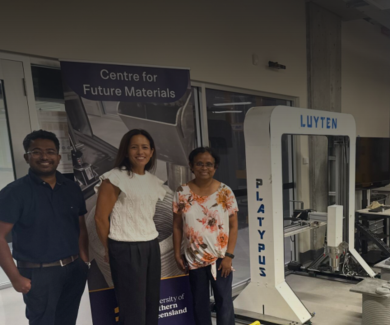
Saya Ramakrishnan, Akilesh Ramesh, and Weena Lokuge formed the research team at UniSQ. Their studies found that the unique fibrous structure of the textile-derived biochar contributed to an approximate 80% increase in early age dynamic yield strength, which suggests potential enhancement in static yield strength.
High static yield strength helps to improve layer stability during the printing process. This is an important consideration in 3D concrete printing, where maintaining the shape and integrity of successive layers is critical to achieving successful builds.
Saya Ramakrishnan, Akilesh Ramesh, and Weena Lokuge from the University of Southern Queensland, said the successful completion of the preliminary investigation with Vital Chemical demonstrated the value of close collaboration between industry and academia.
“Completing this pilot project has given us a strong evidence base to build on, and we look forward to continuing our work with Vital Chemical as we move towards larger-scale validation.”
The study also demonstrated strong mechanical performance, with all tested directions exceeding 25 MPa compressive strength at 28 days. These findings indicate that the incorporation of biochar can support printable concrete applications while maintaining structural requirements.
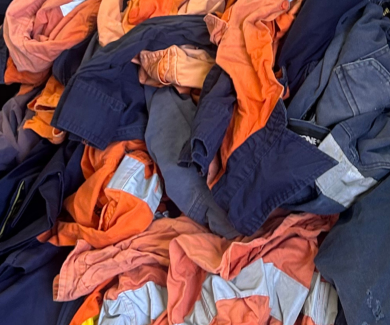
Together, the results suggest potential opportunities for the development of low-carbon 3D-printed walls, panels and other construction elements while diverting end-of-life textiles from landfills.
Asanga De Alwis, Senior Scientific and Sustainability Officer, Vital Chemical, said the development of 3D-printable concrete presents unique technical challenges, requiring careful optimisation of material properties to achieve both printability and structural performance.
“This research has provided valuable insight into how textile-derived biochar interacts within printable concrete systems, with encouraging results demonstrating improved layer stability while maintaining compressive strength.”
Future Opportunities in Circular Construction
Following the successful lab-scale research phase, attention is now turning towards opportunities to further optimise the technology and evaluate future scaled applications.
Vital Chemical and UniSQ are exploring pathways to support large-scale validation, including field trial opportunities and grant funding that may assist in advancing the research.
Leticia Xavier said research projects such as this help identify new pathways and next markets for recovered and alternative materials in emerging industries.
“The knowledge generated through our university collaborations provides an important foundation for future trials, industry partnerships and the development of new and emerging end markets.”
While further work is required and continues, the current findings and outcomes highlight the potential for such innovations to contribute to both sustainable construction practices and the ongoing development of circular economy outcomes.