NEW SALES

Australians bought
1.51 billion items of new clothing, which equates
to 55 items for every Australian, up 6%
from 2023

REUSE

Clothing reuse increased by
10% to 650 million items,
which equates to 11 second hand items for every Australian

RECYCLING

Clothing textiles recycling increased by 7% to
150 million garments,
or 37,500 tonnes

LANDFILL

We sent 220,000 tonnes of clothing to landfill in Australia

Introducing Project ReCarbon

A Seamless Circular Clothing Textiles Fund Supported Project

An Australian‑first carbon recovery model that transforms unwearable construction clothing
and other end‑of‑life textiles, through pyrolysis into a textile biochar that can be
safely returned to the environment.


In collaboration with project partners Earth Systems Australia, Georgiou, Textile Recyclers Group, and Salvos Australia, we are developing and trialling a circular model that diverts textile waste from landfill and converts it into a clean, contaminant‑free carbon suitable for use in hydromulch revegetation applications.

At Vital Chemical we lead the way in researching, developing, manufacturing and supplying innovative, science‑based solutions for erosion and dust control, revegetation and water treatment to help clients achieve operational efficiencies and sustainable outcomes across civil and construction, renewables, mining, residential and commercial development, and land rehabilitation projects.

Project ReCarbon is at the core of our commitment to innovation and sustainability. From the number of clothing items and participants at the five key Georgiou sites, to the sorting and decommissioning of the textiles through to stack emissions testing and the final textile biochar product, the data from Project ReCarbon provides a transparent and detailed analysis of the sustainable foundation of the project and a viable method for the safe return of textile‑derived carbon back into soils.

Project ReCarbon Project Partners

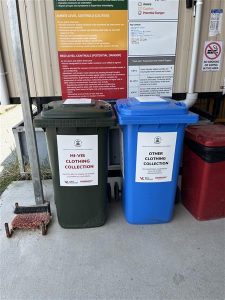
Georgiou supplies unwearable workwear, and other clothing items, from its project sites. These textiles become the feedstock for the project.
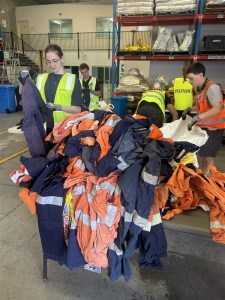
Salvos Australia delivers the textile sorting function through its Project Boomerang technology, including contamination assessment, classification of items as wearable or unwearable, and allocating each item to the most appropriate end use pathway.
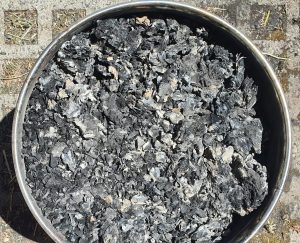
Earth Systems Australia provides the reactor used to conduct the pyrolysis stage of the project and completes the stack emissions testing that verifies the environmental performance of the process.
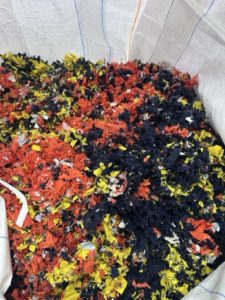
Textile Recyclers Group undertakes the decommissioning of garments by removing non fabric components such as buttons and zips, which can be recycled through alternative pathways, and prepares the textile feedstock through shredding before pyrolysis.
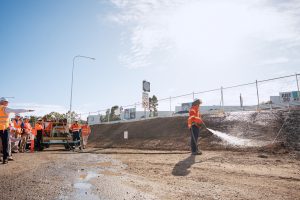
The textile biochar infused hydromulch was applied for use on one of Georgiou’s civil and construction sites in South East Queensland.
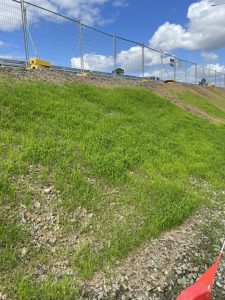
Vital Chemical is working with stakeholders to further develop circular environmental applications for diverting clothing textiles from landfill.

Frequently Asked Questions

Delivered in partnership with Earth Systems Australia, Georgiou, Textile Recyclers Group and Salvos Stores, Project ReCarbon is collecting Hi-Vis PPE from Australian construction sites, and unwearable everyday clothing, and converting it into textile biochar using advanced pyrolysis technology.

The resulting clean carbon is then incorporated into hydromulch for revegetation and returned to the construction sites the clothing came from. It’s a truly circular solution for diverting clothing textiles from landfill.

Pyrolysis is a transformational process and it will transform synthetics and organic materials into more simplified carbon complexes which are repurposed into environmental applications.

We have built a feedstock network utilising a group of carefully selected locally based partners including the Seamless Stewardship, Australian Bedding Stewardship Council, leading Australian designers, construction companies and hospitality businesses.

Through this network, Vital is constructing a collection program for future supply and to help divert clothing and textiles otherwise destined for landfill.

We work closely with social enterprises such as the Salvos Stores Project Boomerang to sort the clothing into a range of categories that can be reused or repurposed.  
Our partner Textile Recyclers Group undertakes a decommissioning process including the removal of non-textile components.   These items are then able to be recycled and repurposed through a range of different streams.  
We have engaged both internal and third party testing to run a full set of testing and analytics on this process including carbon quantification (quantitated and qualitative), feedstock testing (comparative feedstock and biochar analysis and comparative). growth lab studies, PFAS testing, contaminant leachate testing and stack emissions testing.  
The specially engineered technology that Vital has developed for textile pyrolysis has a reduced emissions load which has been independently proven and tested so we can confidently guarantee that the technology does not emit toxins into the environment.
The pyrolysis process is conducted at lower temperatures and is considered to be more environmentally sound to the environment.
 
Incineration requires higher temperatures and can produce air pollutants such as nitrogen oxides, carbon monoxide and particulate matter.
The pyrolysis process and technology thermally decomposes forever chemicals such as PFAS into safer components, ensuring they do not leach into the environment.
Yes, Vital Chemical is committed to only working on textile pyrolysis onshore in Australia with a local partnership network to ensure that the clothing and textiles used are diverted from Australian landfills.
The end-use applications of the textile biochar will be dependent on the feedstocks used throughout the process. The testing undertaken throughout the process will determine which biochars may be returned to the environment for use in environmental applications, including carbon amendments, while others may be incorporated into the built environment, such as concrete-based materials, to support carbon sequestration.
The end-use applications of the textile biochar will be dependent on the feedstocks used Pyrolysis can reduce the mass of textiles down to 25% of its original mass.
Vital Chemical engages with a network of Australian owned and operated businesses. If you would like to discuss opportunities for your business to be involved in the development and application of textile biochar, please contact marketing@vitalindustries.com.au.

We are Committed to Sustainability

Vital Chemical is committed to the continuous improvement of our business functions to ensure the delivery of best value products and services, whilst contributing toward objectives and outcomes aligning with The United Nations Social Development Goals (UNSDGs). Our Australian made products listed on the Infrastructure Sustainability Council (IS Council) ISupply Directory can support your project’s IS Council accreditation submission across a range of qualifying categories.