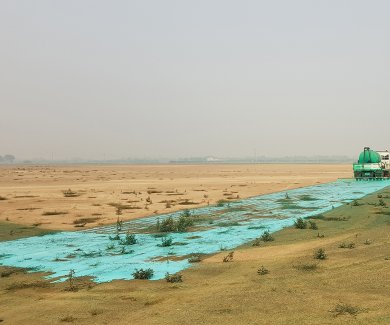
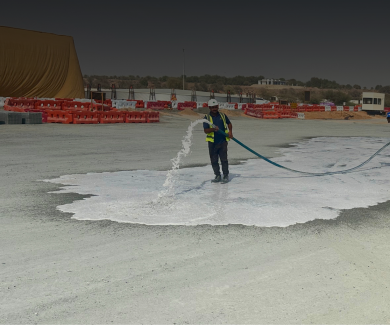
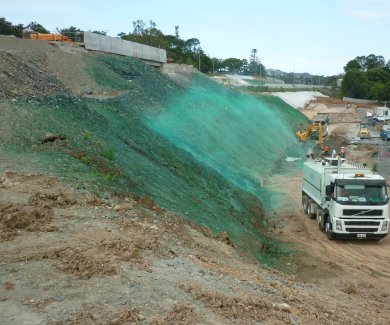
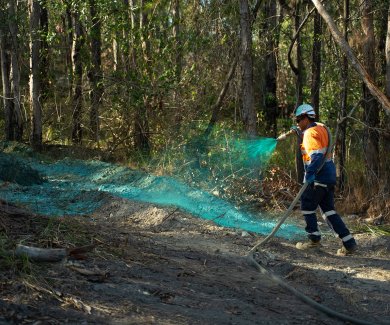
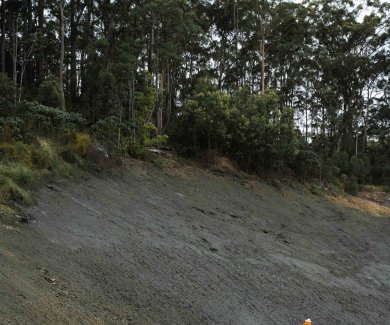
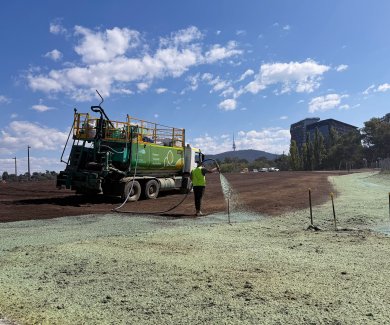
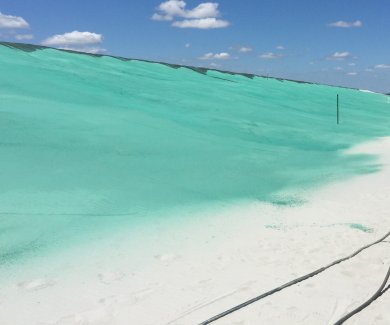
Have you ever wondered why the slope next to a roadworks construction site has been sprayed green?
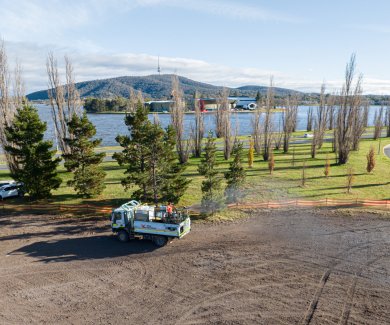
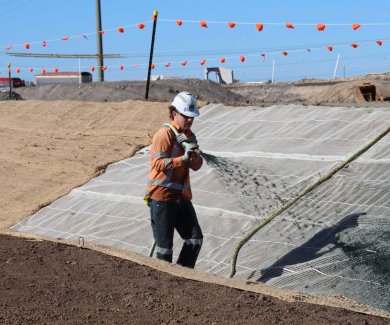
The green product has been applied as an erosion or sediment control measure to stabilise the site. This product application will be for a variety of reasons including reducing the risk of dust pollution in neighbouring communities, stopping sediment run off during rain events moving into nearby waterways or preventing erosion of soils.
To determine whether the product is suitable for the site and will perform as intended, project teams will generally look at several key performance indicators.
Performance Criteria for Effective Erosion and Sediment Control
- Curing time. Ideally the solution will stabilise the soils quickly and cure within hours of application on a dry surface.
- Resistance to the elements. Once cured and dry, the product is expected to remain in place and not remobilise when exposed to wet or windy conditions, reducing the risk of sediment pollution.
- Suitability for the surface type. A trafficked surface will require a more robust and durable solution than an area that does not have vehicles on it.
- Suitability for the project timeframe. Some projects require stabilisation for only a few weeks or months, while others may require coverage for up to 12 months.
- Environmental outcomes. Prevention of soils and subsoils running into waterways and polluting these receiving environments is paramount for the flora and fauna around the project and for the environment as a whole. Employment f these products ensures will determine the sustainable legacy of the project.
These considerations help ensure the selected product will remain effective for the duration of the works and withstand the environmental and operational conditions of the site.
Regulatory Compliance and Industry Best Practice
Erosion and sediment control is a key area of concern and is a compliance requirement for many construction sectors across Australia. Governing authorities including government departments, regional councils and key industry bodies recommend or require exposed areas to be locked down with approved erosion control products to prevent sediment from mobilising and becoming an environmental risk as a result of wind or rain events.
In addition to these requirements, the Australasian Chapter of the International Erosion Control Association has developed its Best Practice Erosion & Sediment Control (BPESC) framework. First published in 2018, this framework provides a periodically reviewed and updated resource to support best practice in erosion and sediment control across Australia.
Adding green dyes to the product composition enables such products to be highly visible, and the project team can clearly demonstrate they have adhered to and achieved the appropriate regulatory compliance.
For this reason, understanding what specific type of dye is being used becomes an important part of choosing an environmentally sound solution that minimises environmental risk.
Avoiding Risks to the Environment
Malachite green is a synthetic chemical that dissolves readily in water, remains environmentally persistent and poses acute toxicity risks to aquatic organisms and humans. Its application as a soil stabilising dye is highly hazardous, with studies* indicating it has the potential to:
- Harm aquatic organisms, even at low concentrations
- Contaminate the food chain through uptake by plants and animals
- Build-up in the human body over time (bioaccumulation)
- Possess potential carcinogenic risks to humans and wildlife
Non‑Toxic Formulations for a Safer, Sustainable Legacy
At Vital Chemical we can incorporate a non‑toxic green dye into our product formulations that is certified non‑hazardous according to criteria set by Safe Work Australia and the NZ Environmental Protection Authority.
Our soil stabilisation products, manufactured in Australia, provide clients with the reassurance that they will visibly achieve regulatory compliance. As a business Vital maintains a strict commitment to environmental safety, which is why our products do not contain malachite green or other associated toxic components.
Every Vital Chemical formulation is analytically tested, field trialled and independently assessed prior to market entry, with validation carried out by accredited testing authorities, leading universities and independent consultants. This rigorous process removes the risk for clients, ensuring they receive reliable, best value solutions without relying on harmful dyes or persistent synthetic chemicals.
Vital has undertaken Environmental Product Declarations (EPDs) to transparently communicate the environmental impact and performance of its flagship erosion and sediment control range.–. This range provides efficient, proven and environmentally sound erosion control, dust management and revegetation solutions for mines, civil construction, residential development and commercial infrastructure projects. Vital’s purpose made products – Vital Bon-Matt Stonewall (IGD), Vital Bon-Matt HR, Vital Bon-Matt P47-VR1 and VE Gro-Matt – are unequalled in their suitability, durability, safety, sustainability and functionality.
Together, these measures help project teams meet regulatory expectations while helping to ensure a sustainable legacy across a diverse range of site conditions and unique project requirements.